Showing posts with label Native-Americans. Show all posts

Tuesday, November 14, 2023

On Thanksgiving and the Dispossessed


  I have often thought that the plight of the Palestinians and Native-Americans is very similar.­ Both groups have had their land taken away by force and trickery, with settlers claiming they had some special or divine right to the land. In both cases, large numbers of their people have been killed off or pushed into containment areas, refugee camps or reservations. In both cases observers believe that what has happened to the indigenous people of North America and what is happening to the Palestinians qualifies as genocide. In 2012, shortly after Thanksgiving, I wrote about the bitterness that so many Native people have about this day, since they feel they have nothing to be thankful for. I also wrote about the parallel experiences of the Palestinians, who were being attacked then just as they are today.


By Reginald Johnson
Dec. 11, 2012


Like most Americans, I’ve always loved Thanksgiving. It’s a day to share good times with family and friends, have a wonderful meal and yes, be thankful for what we have.

I must say that now, however, I have different perspective, after having attended an event put on by American Indians in Plymouth, Mass. called “The National Day of Mourning” on Thanksgiving Day, Nov. 22. I had heard about this event for years, but never got around to going. It was an eye-opener.

Plymouth, of course, is where English Pilgrims arrived aboard the Mayflower in 1620 and began a settlement that many Americans associate with the start of the United States. The first Thanksgiving, at least according to legend, took place a year later and saw the Pilgrims partaking in a meal with Indians, “giving thanks” for a bountiful harvest and for having successfully lived their first year in the “New World.”

Most Americans, I think, see this history in a pretty positive way. The Pilgrims, fleeing religious persecution in England, made a settlement that laid the groundwork for what later would become America, a democratic society where people could practice their religion freely and speak and write as they wished. Many Americans are aware that at the same time, the evolution of our country was not all smooth, that Native people (not to mention Africans, who were held in bondage as slaves) were treated terribly, there was a lot of killing and the English and other Europeans broke agreements and stole Indian land.

But the mythology surrounding the Mayflower, the Pilgrim settlement, the march westward and “the birth of a nation” is so strong that the Indian side of the story, and just how bad the Indians got treated, tends to get lost. Also, in the view of many present-day Natives, there hasn’t been enough teaching in the schools about the Native American history so people will better know what indigenous people have gone through.

“The National Day of Mourning” is an effort to educate people about the Indian narrative of what actually took place in those early years of the country as well as to “honor Native ancestors and the struggles of Native people to survive today,” in the words of a statement by the United American Indians of New England, which holds the event.

A plaque put up on Cole’s Hill ---- overlooking the bay where a replica of the Mayflower is docked and above the fabled “Plymouth Rock,” where the Pilgrims allegedly first stepped on shore ---- captures the harsh view that many Indians have about the beginnings of this country. It reads in part: “Many Native Americans do not celebrate the arrival of the Pilgrims and other European settlers. To them, Thanksgiving Day is a reminder of the genocide of millions of their people, the theft of their lands, and the relentless assault on their culture.”

Moonanum James, a Wampanoag Indian whose ancestors greeted the Pilgrims when they arrived, talked of the many distortions in history about what occurred in the early days and the Pilgrims themselves.

“When they arrived, they didn’t find an empty land. Every inch of this land was Indian land,” he said in a speech before about 400 people on Cole’s Hill.

James said that by the written account of one of the Pilgrims themselves, in the first year settlers went out and robbed Indian graves, stole crops, kidnapped Natives and sold them into slavery for 220 shillings apiece.

James, co-leader of the UAINE organization, also said that the legend of Thanksgiving beginning with a peaceful dinner in 1621 with the Indians was erroneous. He maintained that the first official Thanksgiving Day took place in 1637, when the head of the Massachusetts Bay Colony, Gov. John Winthrop, proclaimed a “Day of Thanksgiving,” celebrating the safe return of 200 volunteers who had gone to Mystic, Connecticut and slaughtered 700 women, children and men of the Pequot tribe.


Some historical accounts hold that in the area of eastern Massachusetts there was relative peace for a number of decades between the colonists and Indians. But by the 1670s, trouble was brewing, with the Indians fed up with mistreatment by the colonists and constant land encroachments. Metacomet, the son of the Wampanoag leader Massasoit, who had greeted the Pilgrims, decided to unite all the Indian tribes and drive the English back.

For two years, Metacomet, also known as King Philip, led Native warriors in battles over much of southern New England. Thousands were killed in the conflict. Eventually, the English forces proved too strong, and King Philip was captured and killed, and the war all but ended.

The victors weren’t satisfied with killing the Indian leader and subduing Native forces. They mutilated Metacomet’s body, decapitated him and put his head on a pole for public observation in a Plymouth square. The skull remained there for 20 years.

Moonanum called Plymouth Rock “a monument to racism and oppression” which he and Indian activists had covered with sand on two occasions.

In their suffering, Moonanum said, Natives had a lot in common with African-Americans, who were kidnapped and brought here from Africa to be slaves on cotton plantations.

He recalled black leader Malcolm X’s quote about Plymouth Rock. “We didn’t land on Plymouth Rock. Plymouth Rock landed on us.”

James and others said conditions for Native people today --- who represent about 1.5 percent of the country’s population --- are very difficult. A large proportion of Indians live on reservations, and the poverty rampant. Alcoholism and suicide rates are high.

This was the 43rd National Day of Mourning, with the first one being in 1970. James said not much has changed for Indians since then. Just as they did at the first event in 1970, Indians are demanding an end to the Bureau of Indian Affairs, a branch of the U.S. Dept. of Interior, which manages the reservations.

James called the BIA “corrupt.” He said Indians should be allowed to manage their reservations on their own.

Others spoke at the rally, including Tiokasin Ghosthorse, a Lakota Sioux who has a radio show called “Indigenous Voices” aired on a number of stations including WBAI in New York and WPKN in Bridgeport, Ct.. Tiokasin spoke of environmental issues and how there had to be more respect for “mother earth.” He said present day American society is “abusing mother earth,” and this will backfire.


Other speakers expressed empathy for the Palestinian people, who in early November had to endure yet another attack by the Israeli military in Gaza. Some 200 people were killed, many of them children.

Speakers said the Palestinians were a “dispossessed people,” much like the Native people here. One UAINE speaker said the Israeli leaders were showing the same callous and racist disregard for human life in Gaza as the U.S. military showed in its wars against the Indians. She said comments by officials to the effect that Gaza should be “flattened” and “bombed back to the Middle Ages” were similar to remarks made by an Indian fighter, Colonel John Chivington.

Chivington led forces which carried out the Sand Creek, Colorado massacre, in which over 200 largely unarmed Indians were killed in 1864.

Two weeks prior to the expedition, Chivington promised a Denver audience that he would kill all Indians he encountered, including children. “Nits make lice,” he said.

A letter of support from imprisoned Indian activist Leonard Peltier was read as well. In a highly-controversial case, Peltier has been locked up in federal prison for over 35 years following a conviction for killing two FBI agents in a gunbattle on the Pine Ridge reservation in South Dakota.

However, considerable information has emerged that casts doubt on the validity of the conviction, and there’s been a decades-long campaign to have Peltier released.

The rally was followed by a march through the quiet streets of Plymouth. (Just days before, leaders of the town, which bills itself as “America’s Hometown,” had a Thanksgiving celebration, featuring a “Pilgrim’s Parade”). The marchers chanted as they walked past picturesque colonial-era homes, churches, the Mayflower and Plymouth Rock. There were a few curious onlookers, although most residents were inside having Thanksgiving dinner or watching a football game.

At the front of the march was a banner which read: “We are not vanishing. We are not conquered. We are as strong as ever.”




Monday, May 2, 2022

Indigenous people and Remington Woods


By Reginald Johnson


  BRIDGEPORT, CT --- The Remington Woods open space tract --- zoned by the city for commercial and residential development --- may have been an area where indigenous people lived thousands of years ago.

  In the late 1990s, when development ideas for the woods were first discussed, then Connecticut State Archaeologist Nicholas Bellantoni did an assessment survey of the area. Bellantoni recommended that the 423-acre forest be preserved due to “archaeological sensitivity” and called for a full exploration and inventory of findings.

   That full exploration was never done and Bellantoni, now retired, could not be reached for extensive comment on his research. But local resident Jeff Kohut, who was in touch with Bellantoni at the time, said that the state official based his recommendation in good part on the discovery decades earlier of artifacts from a Native-American camp on land right next to Remington Woods.

  That land is where the Nob Hill Condominiums, on Nob Hill Circle in the northeast section of Bridgeport, now sit. Kohut said that ancient Indian artifacts were discovered during the construction of the condos just after World War II. The artifacts, dating to 7,000 years ago, indicated the presence of a camp and tool making site and “prolonged habitation.”

  “Unfortunately, the artifacts were discovered only after major disruption of the site/building had occurred, so a full assessment/reconstruction of the habitation by Native Americans was impossible,” said Kohut.

 Kohut said Bellantoni had also located 7,000-year old habitation sites in the Pequonnock River Valley in Trumbull, about 1 mile from Remington Woods. The Pequonnock River Valley is close to Church Hill Road and Daniels Farm Road.

  Kohut also noted that he had discovered ancient artifacts, including an arrowhead and ax head, on property in the Lake Forest area of Bridgeport, also about 1 mile from Remington Woods. The artifacts were authenticated by Bellantoni and also dated from 7,000 years ago.

  The current state archaeologist, Sarah Sportman, said that prior to the creation of a lake on the Remington property (Lake Success),  “there were streams and wetlands which likely made the area attractive to indigenous people.”


The lake at Remington Woods. Ancient indigenous artifacts were found nearby. 

  Currently, the property is owned by the Sporting Goods company, a subsidiary of Corteva Corporation, previously part of DuPont. The tract --- of which 347 acres are in Bridgeport and 76 acres in Stratford --- was once used by the Remington Arms company to test guns and ammunition. In recent years, there has been an EPA-monitored hazardous waste clean-up of the area.

  Sporting Goods officials are now mulling options for development of the site, following the city’s approval of a zoning designation of “Residential-Office” late last year.

  That approval came after dozens of people spoke out at a public hearing supporting the idea of preserving the woods as open space and as a wildlife refuge. Some speakers also raised the archaeological questions associated with the site and wondered why development would be allowed to go ahead with those questions unanswered. 


Artifacts dating to 7,000 years ago, found in the Lake Forest area, about a mile from Remington Woods.

  According to multiple histories of the southern Connecticut area, indigenous people, primarily the Paugussett tribe, inhabited the region for centuries if not millenia prior to the arrival of European settlers.

  “The Golden Hill Paugussett Tribe has been a part of Greater Bridgeport’s history from time immemorial,” said Charles Brilvitch, an historian and author of the book “A History of Connecticut’s Golden Hill Paugussett Tribe.”

  Brilvitch said the Paugussetts lived in a number of areas of what is now Bridgeport, Trumbull, Stratford and Fairfield. There were Paugussett villages in the area of Golden Hill Street and Elm Street in downtown Bridgeport; on land where Mountain Grove cemetery sits near the mouth of Ash Creek; and at the head of Johnson’s Creek near the Bridgeport-Stratford line, among other locations, he said.


Downtown Bridgeport, not far from City Hall. Centuries ago, the Golden Hill Paugussett Tribe had a village on this land. 

  After Dutch and English immigrants arrived in the 16th and 17th centuries, the Paugussetts were systematically driven off their land, either violently by settlers or by government decree. 

  Today, a small Paugussett tribe remains, with a quarter-acre reservation in Trumbull.

  A Paugussett leader said the tribe is in the beginning stages of finding out what’s going on at Remington Woods and what the Sporting Goods company has in mind.

  “We are planning on having a meeting with them so that our council and us can go to the land. We can talk, we can meet, we can see, get our questions out and see what they have to say before we can comment on anything,” said Shoran, the Clan Mother and Tribal Head Leader of the Golden Hill Paugussetts.


Friday, January 6, 2017

Free Leonard Peltier


By Reginald Johnson

  
  In his remaining days in office, President Obama has the opportunity to bring some measure of justice to wrongfully-imprisoned Native-American activist Leonard Peltier.

  Peltier has been languishing in prison for over 40 years, following his conviction for murdering two FBI agents during a shootout between law enforcement officers and Lakota Indians on the Pine Ridge Indian Reservation in South Dakota in 1975.

   Peltier is a political prisoner --- one whose arrest, conviction and lengthy incarceration was determined not so much by the facts of the case but by Peltier’s activism in the American Indian Movement and the government’s desire to suppress a rebellion by Native Americans in the 1970s.

 The entire process by which Peltier was arrested and tried was fraught with problems.  Witness affidavits supporting Peltier’s extradition from Canada (where he fled after the shootout) prior to his arrest were gained through coercion; during the trial the government withheld key documents, such as ballistics information, that could have aided the defense; witnesses who testified for the prosecution later recanted and said the FBI had pressured them to implicate Peltier.


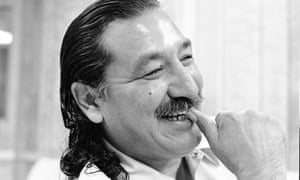
Leonard Peltier, pictured at Leavenworth federal prison in 1992, is serving two consecutive life sentences for the murders of two FBI agents in 1975.
Leonard Peltier, the Native American activist who is asking for clemency from President Obama after 40 years in prison. (Photo courtesy of The Guardian)
   

   While Peltier was unsuccessful in an appeal of his conviction, the presiding judge in the appeals hearing, Gerald Heaney, harshly criticized the prosecution for the FBI’s “improper conduct” and “clear abuse of the investigative process,” according to a report by the Center for Constitutional Rights.

   It’s also noteworthy, that during the appeals hearing, the government admitted that they couldn’t prove who actually shot the agents. But the government still maintained that Peltier was linked to the murders and therefore was guilty.  

  The idea that someone could be convicted and sent to prison for so many years --- based on such a shaky prosecution case, rife with so many legal problems, is an outrage.

  It is not the kind of thing that is supposed to happen in a democratic republic, with a system that on paper at least provides “liberty and justice for all.”  The Peltier case is more befitting of what happens in a dictatorship.
  
    Obama has a chance to end this outrage by granting Peltier’s request for clemency.  The Native activist has gotten wide support for his plea --- from human rights groups like Amnesty International to Bishop Desmond Tutu to thousands of people signing petitions.  And just this week, Peltier got unexpected support from one of the prosecutors in the original case. Former U.S. Attorney James Reynolds told The Guardian newspaper that it was time for the government to “call it quits” and grant leniency to Peltier.
 
   In addition to the facts of the case and the wide support Peltier has received, Obama should also consider Peltier’s age and his declining health. Now 72, Peltier has suffered a stroke and battled diabetes and a heart condition.
 
  This is not the first time Peltier has sought clemency. In 2000, former President Bill Clinton weighed his request for leniency (just as Clinton was leaving office) but ultimately denied it after members of the FBI Agents Association mounted a furious opposition campaign and picketed the White House.

  The FBI group --- composed of former agents of the federal agency --- are again opposing Peltier’s petition.

  Hopefully President Obama --- who is ending his tenure in the White House on Jan. 20 --- will see the light in this case and not back down. A good sign is that Obama has recently been granting leniency for hundreds of other long-time prisoners --- offenders who were serving excessively long terms for drug convictions.

 President Obama needs to grant freedom to Leonard Peltier --- now.


(For more information on the Leonard Peltier case and to sign a petition calling for his release, go to www.amnestyusa.org. Additional information on Peltier and other political prisoners such as Puerto Rican activist Oscar Lopez Rivera and Army whistle-blower Chelsea Manning as well as NSA whistle-blower Edward Snowden, who is being unfairly accused of espionage, can be found at www.lawanddisorder.org, Dec. 19, 2016 show)